2025-12-11T11:30:51Z How to Choose the Right Pipette for Your Lab Application
Selecting the right pipette for your laboratory work is more than just picking a tool off the shelf; it's about matching instruments with specific applications you’re using. This comprehensive guide demystifies pipette selection by matching specific laboratory applications with the right liquid handling tools . Rather than overwhelming you with technical specifications, we focus on real-world scenarios across molecular biology, cell culture, immunology, microbiology and clinical diagnostics to help you identify which pipette types , volume ranges and features will deliver reliable results for your specific workflows.
Understanding the Fundamentals: Air Displacement vs. Positive Displacement
Before diving into application-specific recommendations, it's crucial to understand the two main pipetting technologies:
Air Displacement Pipettes
Air displacement pipettes use a piston to create negative or positive pressure within the pipette shaft, drawing liquid into or expelling it from disposable tips. An air cushion between the piston and liquid ensures contamination-free handling - perfect for aqueous solutions and standard reagents.
Best for: Buffers, media, diluted samples and most routine laboratory liquids
Limitations: Can struggle with viscous, volatile or foaming liquids
Positive Displacement Pipettes
In these specialized instruments, the piston directly contacts the liquid within a disposable syringe-like tip. Without an air cushion to affect accuracy, positive displacement pipettes deliver consistent results regardless of liquid properties. Notable examples include the Transferpettor , Socorex Acura 841 and Drummond's micro dispensers .
Best for : Viscous solutions (glycerol, oils), volatile solvents (ethanol, chloroform), corrosive chemicals and high-density liquids
Trade-offs: Higher consumable costs, more frequent tip changes required
Application-Specific Pipette Selection Guide
Effective liquid handling starts with recognizing that different disciplines and workflows call for different tools . PCR setup, cell culture transfers, ELISAs, and microbiology protocols each bring their own challenges. In the next section, we connect common laboratory applications with the pipettes that suit them best , taking into account volume range, liquid behavior, throughput and contamination risks.
Molecular Biology & PCR Applications
These applications typically involve expensive reagents , precious samples and contamination-sensitive protocols that require specialized pipetting techniques and equipment. The success of downstream applications (such as sequencing, cloning and gene expression analysis) depends heavily on accurate pipetting during initial setup phases. Modern molecular biology laboratories must balance the need for ultra-precise single-sample handling with increasingly common high-throughput requirements for genomics and screening applications.
Primary Requirements:
Ultra-precise small volume handling (0.1-20 µL)
Contamination prevention
Consistent dispensing for reproducible amplification
Recommended Pipettes:
PCR Setup: Single-channel adjustable pipettes ( 0.5-10 µL , 2-20 µL ranges)
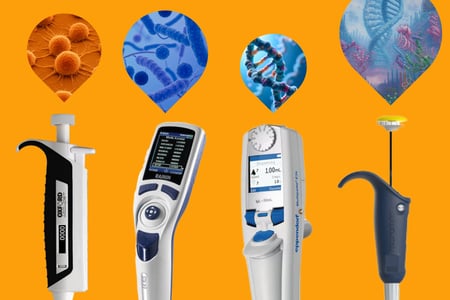
qPCR Master Mix Distribution: Electronic pipettes with repeat dispensing mode like Oxford Lab BenchMate E , Integra VIAFLO , Labnet Excel , DWK Socorex Acura Electro , Rainin E4 XLS or Sartorius Picus
High-throughput Genotyping: 8- or 12-channel pipettes (0.5-10 µL)
Essential Features:
Low-force tip ejection to minimize aerosol generation ( LTS compatible options)
Compatible with filter tips (aerosol barrier tips)
Volume lock capability to prevent accidental adjustment during repetitive work
Pro Tip: For PCR work, accuracy between 30-100% of the pipette's maximum volume is optimal. A 2-20 µL pipette is more accurate at 5 µL than a 5-50 µL model.
Cell Culture Applications
The dynamic range of volumes in cell culture varies from microliters for growth factor addition to millilitres for media exchanges. This requires a versatile pipetting strategy that maintains aseptic technique throughout. Additionally, it depends on "gentle" liquid handling that minimizes shear stress and consistent seeding densities for reproducible experiments. It is also important to note the repetitive nature of cell culture maintenance that makes ergonomic considerations more pronounced since user fatigue and technique quality become affected over extended pipetting sessions.
Primary Requirements:
Sterile technique maintenance
Gentle handling for cell viability
Range flexibility (microliters to milliliters)
Recommended Pipettes:
Media Changes: Single-channel pipettes ( 100-1000 µL , 1-5 mL ) such as Oxford Lab Benchmate Plus , IKA Pette Vario , Transferpette pro , DWK Socorex Acura , Eppendorf Research Plus , Biopette Plus or Sartorius Tacta - all fully autoclavable models
Cell Seeding in Plates: Multichannel pipettes ( 20-200 µL ) or electronic repeat dispensers like Eppendorf E3x or the HandyStep
Cell Counting/Dilutions: Single-channel ( 2-20 µL , 20-200 µL )
Essential Features:
Autoclavable lower parts or UV-resistant materials
Smooth plunger action for controlled dispensing
Wide-bore tips available for sensitive cell types
Application Note: Electronic pipettes with customizable programs excel at standardizing cell culture protocols, reducing variability between operators.
Immunology & ELISA
Consistency across all wells directly impacts assay reliability and data quality for immunological assays. These plate-based techniques require careful coordination of multiple liquid handling steps - coating, blocking, sample addition, washing and detection. Each handling step comes with a specific volume and timing requirement that can affect signal-to-noise ratios and assay sensitivity. The serial dilution requirements common for immunology work demand exceptional accuracy and precision to maintain proper antibody or antigen concentrations across multiple dilution points.
Primary Requirements:
Precise multichannel dispensing for plate-based assays
Consistency across all channels
Efficient serial dilutions
Recommended Pipettes:
Plate Coating/Washing: 8- or 12-channel pipettes (50-300 µL)
Sample/Standard Addition: Multichannel ( 5-50 µL or 20-200 µL ) with options like CAPP Aero that comes in 16-, 48- and 64-channel options
Substrate Addition: Electronic multichannel for simultaneous dispensing (Oxford Lab BenchMate E , Integra VIAFLO , Labnet Excel , DWK Socorex Acura Electro , Rainin E4 XLS or Sartorius Picus )
Essential Features:
Channel-to-channel precision ≤2% CV
Ergonomic design for repetitive use
Compatible with reagent reservoirs
Workflow Optimization: Consider electronic pipettes with mixing functions for antibody dilutions and multi-dispense modes for adding stop solutions.
Microbiology Applications
The variety of liquid types in microbiology (from thin bacterial suspensions to thick agar solutions and glycerol stocks) challenges standard pipetting equipment with extra variation. It often requires specialized approaches or positive displacement technology for a diverse range of protocols. Prevention of cross-contamination remains paramount while most quantitative aspects of modern microbiology depend on accurate and consistent liquid handling for reliable results - be it CFU counting, MIC determination or a growth curve analysis.
Primary Requirements:
Wide volume range for diverse protocols
Contamination control
Ability to handle both liquid and viscous media
Recommended Pipettes:
Bacterial Culture Work: Single-channel (10-100 µL, 100-1000 µL) models like Transferpette S , Nichipet Premium , VWR EHP or CAPP's Microbiology pipette. Consider an electronic model like the CELLTREAT Ovation
96-Well Plate Inoculation: 8-channel pipettes (5-50 µL)
Agar/Viscous Media: Positive displacement pipettes like Transferpettor , Socorex Acura 841 and Drummond's micro dispensers or or wide-bore tips
Essential Features:
Chemical resistance for decontamination procedures
Filter tip compatibility for sterile work
Positive displacement options for viscous growth media
Workflow Optimization: Even in microbiology, multichannel pipettes dramatically reduce variability when plating multiple replicates or performing MIC assays
Clinical & Diagnostic Laboratories
These environments demand not only technical precision but also comprehensive documentation . Most procedures must be possible to trace back and have to comply with standards like ISO 15189, CLIA and CAP that govern medical laboratory operations. Biological samples like blood, serum, plasma and other body fluids require special consideration for operator safety, sample integrity and carry-over contamination prevention .
Primary Requirements:
Compliance with regulatory standards (ISO 8655, GLP/GMP)
Traceable calibration
High precision for patient samples
Recommended Pipettes:
Blood/Serum Samples: Fixed-volume pipettes for critical measurements (like the IKA Pette , Oxford Lab Accupet Pro , Celltreat mLA Micro D-Tipper , Eppendorf's Reference 2 or Labnet's Labpette FX )
Reagent Preparation: Electronic pipettes with password protection and audit trails (CAPP Maestro , Sartorius Picus 2 and E-1 Clip Tip )
High-throughput Screening: Automated or semi-automated systems like the AutoMATE™ 96
Essential Features:
Calibration certificates and service documentation
RFID or digital tracking capabilities
Low dead volume for precious samples
Application Note: Use multichannel or electronic pipettes for ELISAs, batch PCR setups and QC plate preparations
Critical Selection Factors Beyond Application
Several universal factors significantly impact laboratory efficiency and user satisfaction beyond use for specific applications. These factors often determine the difference between a functional liquid handling setup and an optimized system that enhances productivity .
Volume Range Optimization
The sweet spot for accuracy lies between 30-100% of a pipette's maximum capacity. Consider your most frequent volumes:
If you routinely pipette 15 µL, choose a 2-20 µL pipette over a 10-100 µL model
For variable protocols, maintain a set covering overlapping ranges
Ergonomic Considerations
Pipetting-related repetitive strain injuries are real concerns in busy laboratories:
Weight: Lighter models reduce hand fatigue during extended use
Plunger Forces: Low-force designs decrease thumb stress
Grip Design: Contoured handles improve comfort and control
Electronic Options: Motorized aspiration eliminates manual plunger depression
Tip System Compatibility
Your pipette-tip combination directly impacts accuracy:
Universal Fit: Offers flexibility but may compromise seal quality
Proprietary Systems: Ensure optimal seal but limit tip options
LTS (Low-Force Tip System): Reduces insertion and ejection forces
Filter Tips: Essential for PCR, cell culture, and contamination-sensitive work
Throughput Requirements
Match your pipette format to your workflow demands:
Daily Sample Volume
Recommended Format
<50 samples
Manual single-channel
50–200 samples
Electronic single-channel or manual multichannel
200–500 samples
Electronic multichannel
>500 samples
Automated liquid handling system like AutoMATE™ 96
Maintenance and Calibration
Consider long-term ownership costs:
In-house Calibration: Requires equipment and trained personnel
Service Contracts: Ensure compliance but add recurring costs
Calibration Frequency: Critical applications may require monthly checks
Spare Parts Availability: Seals and o-rings should be readily available
A smart evaluation of these additional elements can help ensure your pipetting infrastructure supports both current needs and future laboratory growth .
Advanced Features for Specialized Applications
Modern pipetting technology offers additional features that address specific workflow needs with automation, programmability and specialized mechanical designs. These advanced features enhanced purely mechanical pipettes to electronic and smart pipettes which allow data integration, protocol standardization and compliance documentation for a contemporary laboratory environment.
Electronic Pipettes: When Digital Precision Matters
Modern electronic pipettes offer capabilities beyond simple aspiration and dispensing:
Multi-dispensing: Distribute reagents to multiple wells from a single aspiration
Diluting: Automated serial dilutions with mixing
Reverse Pipetting: Improved accuracy for viscous or foaming liquids
Custom Programs: Store complex protocols for consistency
Ideal for: GxP environments, method standardization, reducing user variability
Specialty Pipettes for Unique Challenges
Repeater Pipettes combine positive displacement with rapid multi-dispensing - perfect for:
Dispensing viscous liquids into multiple vessels
Adding reagents to large numbers of tubes
Working with foaming detergents or volatile solvents
Adjustable Spacer Multichannel Pipettes offer variable tip spacing accommodates different labware formats:
Transfer between tubes and plates
Work with both 96- and 384-well formats
Access non-standard vessel arrangements
Understanding when advanced features justify their premium pricing helps deliver measurable value in applications where consistency, traceability and ergonomics directly impact operational efficiency.
Building Your Pipette Portfolio: A Practical Approach
Rather than purchasing pipettes individually, a systematic approach to portfolio development can ensure a seamless workflow coverage and help cut down unnecessary expense. The optimal pipette collection varies, and this section is meant to help providing concrete recommendations for pipette sets tailored to specific laboratory types.
For a New Molecular Biology Lab
The initial pipette investment must support core techniques like DNA/RNA extraction, PCR amplification, cloning procedures and protein analysis while accommodating both individual sample processing and increasingly common plate-based formats . The recommendations below represents the minimum viable pipette portfolio for a functional molecular biology laboratory, with suggested additions for enhanced capability.
Essential Set:
0.5-10 µL single-channel (PCR setup)
2-20 µL single-channel (general use)
20-200 µL single-channel (dilutions)
100-1000 µL single-channel (buffer prep)
8-channel 0.5-10 µL (high-throughput PCR)
Establishing a molecular biology laboratory requires careful consideration of the diverse liquid handling needs spanning from sub-microliter PCR setup to milliliter-scale buffer preparation.
For a Cell Culture Facility
The daily workflow of maintaining multiple cell lines involves frequent media changes, passaging operations and experimental treatments. This demands both precision and speed, making ergonomic considerations particularly important for culture room staff. A well-designed cell culture pipette portfolio minimizes contamination risk while maximizing efficiency in routine maintenance tasks and experimental procedures.
Core Collection:
2-20 µL single-channel (cell counting)
20-200 µL single-channel (general use)
100-1000 µL single-channel (media work)
1-5 mL single-channel (large volume media)
8-channel 50-300 µL (plate seeding)
Cell culture facilities require pipetting equipment that spans an exceptionally broad volume range while maintaining compatibility with aseptic technique requirements and biosafety cabinet constraints.
For an Immunology Research Lab
The precision requirements of antibody titrations, cytokine quantification and flow cytometry sample preparation demand exceptional pipette accuracy and channel-to-channel consistency. Immunology laboratories center their operations around plate-based assays and serial dilutions , making multichannel pipetting essential. The following recommendations address both traditional immunological techniques and emerging high-throughput applications.
Recommended Suite:
2-20 µL single-channel (antibody dilutions)
20-200 µL 8-channel (ELISA plates)
50-300 µL 8-channel (washing steps)
Electronic multichannel (standardization)
Modern immunology research increasingly involves multiplex assays and high-content screening approaches that benefit from electronic pipetting features like programmable protocols and consistent timing.
Quality Assurance: Maintaining Peak Performance
A consistent pipette performance requires a comprehensive quality assurance program that encompasses daily user checks, periodic verification, professional calibration and preventive maintenance - all to ensure the instrument's proper accuracy throughout its operational lifetime. Laboratory accreditation standards and regulatory compliance often mandate specific QA procedures and documentation for routine laboratory operations.
Daily Checks
Visual inspection for damage
Leak testing with distilled water
Smooth plunger operation verification
Monthly Validation
Gravimetric testing at multiple volumes
Channel consistency checks (multichannel)
Documentation in equipment logs
Annual Certification
Professional calibration service
Replacement of wearing parts
Compliance documentation updates
An investment in proper pipette maintenance becomes worthwhile through reduced experimental variability, fewer repeated experiments, extended equipment lifespan and a well-maintained compliance with quality standards.
Cost-Benefit Analysis: Making the Investment Decision
The true cost of pipetting extends beyond initial purchase price. Consumables, maintenance, calibration, potential experimental failures and the human factor all contribute to additional expense . Sophisticated laboratories have long since recognized that premium pipetting equipment can deliver a positive return on investment with decreased likelihood of repetitive strain injuries.
When evaluating pipettes, consider the total cost of ownership:
Direct Costs:
Initial purchase price
Consumable tips
Calibration services
Replacement parts
Hidden Costs:
Experimental repeats due to pipetting errors
User injury/discomfort from poor ergonomics
Workflow inefficiencies
Compliance violations
ROI Factors:
Improved data reproducibility
Reduced reagent waste
Enhanced user satisfaction
Regulatory compliance maintenance
This comprehensive evaluation framework can help your laboratory make an evidence-based decision to balance fiscal responsibility with scientific requirements. A certified refurbished pipette option can help reduce direct costs while providing a regulatory compliant alternative.
Making Your Final Decision: A Practical Checklist
Before purchasing, evaluate:
✓ Application Match: Does the pipette suit your primary use cases?
✓ Volume Range: Is accuracy optimal for your most common volumes?
✓ Ergonomics: Will users be comfortable during extended sessions?
✓ Tip Compatibility: Are appropriate tips readily available?
✓ Service Support: Can you maintain calibration compliance?
✓ Budget Fit: Does total cost of ownership align with resources?
✓ Future Needs: Will the pipette accommodate protocol evolution?
✓ User Training: Is adequate training available for your team?
✓ Vendor Reputation: Does the manufacturer offer reliable support?
✓ Warranty Coverage: What protection exists against defects?
Find The Type of Pipette You Need at Our Store
Choosing the right pipette is about understanding how each instrument serves your specific scientific goals. Whether you're amplifying rare DNA sequences, maintaining delicate cell cultures or conducting high-throughput immunoassays, the right pipette becomes an extension of your scientific expertise.
By matching pipette capabilities to application requirements, you create a foundation for reproducible, reliable results. Remember – the most expensive pipette isn't always the best choice; the optimal pipette is the one that consistently delivers accurate results for your specific applications while keeping users comfortable and workflows efficient.
Ready to upgrade your laboratory's liquid handling capabilities? Explore Pipette.com and our complete selection of single-channel , multichannel and electronic pipettes along with universal and LTS compatible tips, calibration services and maintenance programs.
You might be also interested in:
What Is Microbiology? A Guide to Microbial Science, Lab Techniques, and Equipment
Running PCR in the Lab: Considerations That Matter
What Is Cytology? Exploring Cell-Based Research and Lab Essentials